Thank you for contacting us
Please fill out the form below and we will follow up with you the next business day. We ask for your contact information so that we can follow up with you regarding your request. We will not share it with third parties for unsolicited inquiries.

Refer a Patient Please fill out the form below:

Contact Us Please fill out the form below:

Share your storyPlease fill out the form below:

Thank you for sharing

call us
              

Enter Title

   Minimize

Other Cancer Types

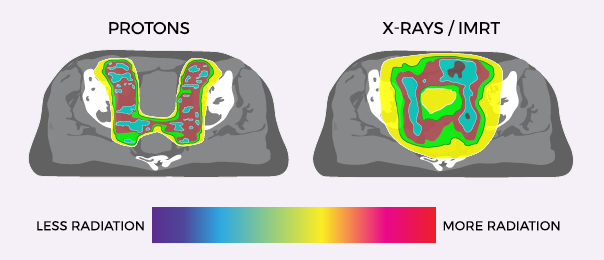
Protons can be controlled with greater precision than X-rays. This means that more energy goes into destroying the tumor and less radiation is delivered to surrounding healthy tissue .1 For this reason, proton therapy is particularly good for treating tumors near healthy organs, including gastrointestinal and lung tumors and tumors of the head, neck, and spine .1-10


Gastrointestinal cancers 


Gastrointestinal (GI) tumors can occur anywhere along the GI tract.

Click image above to enlarge.

GI tract tumors most appropriate for proton therapy include:

  • Esophagus
  • Stomach
  • Pancreas
  • Liver
  • Rectum
  • Anal canal

Treatment for GI tract tumors often requires a combination of radiation therapy and either chemotherapy or surgery. The combination of these therapies can be difficult for patients to tolerate. In some cases, standard radiation isn’t a viable treatment option for patients because it would cause too much damage to healthy tissues and organs near the tumor. For these patients, proton therapy can be an effective treatment option because protons deposit more energy directly to the tumor and significantly reduce the radiation dose to healthy tissues.1 Patients treated with proton therapy for GI tract tumors often experience fewer side effects.2,3

Click image above to enlarge.

Treatment-planning studies for esophageal cancer found that the more precise dose delivered with proton therapy reduced the likelihood of lung complications.2

Click image above to enlarge.

One of the most promising benefits of proton therapy for anal cancer is its ability to deliver a higher dose of radiation to the tumor, providing better tumor control than X-rays.11

Back to top »

Lung tumors

Several research centers are studying the use of proton therapy as a treatment for patients with non-small-cell lung cancer who are not candidates for surgery or are considering an alternative treatment to X-ray radiation.

In one study, researchers compared non-small-cell lung cancer patients receiving proton therapy and concurrent chemotherapy with patients receiving X-ray therapy and chemotherapy.12 The patients treated with protons received a higher dose of radiation than those treated with X-rays. Despite receiving a higher dose of radiation, patients treated with protons were found to have significantly lower rates of pneumonia and swelling of the esophagus after treatment than patients who were treated with X-rays.12

Patients treated with proton therapy and concurrent chemotherapy have also been found to experience significantly less fatigue and anemia than patients treated with intensity-modulated radiation therapy (IMRT) and chemotherapy.6 Proton therapy has also been shown to provide local tumor control with minimal damage to the heart, lungs, and esophagus.4,5

Click image above to enlarge.

High doses of radiation are better for eradicating a tumor, but high doses may also mean that healthy organs and tissue receive more radiation. The charts below show the results of a high-dose study of small-cell-lung cancer that found proton therapy delivered significantly less radiation to the spinal cord and heart than X-rays.

Click image above to enlarge.

Click image above to enlarge.

The same study also found that proton therapy significantly reduced radiation to the heart and spinal cord compared to X-rays for stage I non-small-cell lung cancer. Delivering less radiation to healthy organs reduces the likelihood of side effects.

Back to top »

Head and neck tumors

More than 60,000 Americans are diagnosed annually with head and neck cancer. When treating head and neck tumors it’s critical to protect the delicate organs that surround the tumor. Proton therapy can substantially reduce damage to eyes, optic nerves, salivary glands, and other tissue and organs near head and neck tumors.7-9 Proton therapy also reduces the likelihood of side effects such as blindness, hearing deterioration, and dry mouth.8 Secondary malignancies are also less likely with proton therapy.7

Head and neck tumors treated with proton therapy include7,8,14:

  • Nasopharynx (back of the nose where it meets the throat)
  • Nasal (nose) cavity
  • Paranasal sinuses (sinuses in the face)
  • Oropharynx (area of the throat at the back of the mouth), including the tonsils and base of tongue


Click image above to enlarge.

The images above are from a study of cancer of the nasopharynx.The study found that proton therapy significantly reduced exposure to the spinal cord, ear canal, thyroid, and other critical organs compared with X-rays/IMRT.8

Back to top »

Base-of-skull tumors

These tumors include chordomas and chondrosarcomas. Tumors in the base-of-skull region are difficult to treat because they are often close to critical structures such as the brainstem, brain, cranial nerves, and optic nerves. The location of these tumors often makes surgical removal difficult and limits the dose of radiation that can be delivered with standard X-ray radiation treatments. Proton therapy can be particularly appropriate for these tumors because it minimizes radiation exposure to surrounding healthy tissue. Since these tumors are found at a shallow depth, proton therapy is often able to deliver a high dose of radiation precisely to the tumor without affecting tissues of the brain and spinal cord.10 The more radiation delivered to the tumor the greater the chance of completely destroying it.1

Click image above to enlarge.

The greater precision of proton therapy spares healthy organs, allowing a higher dose of radiation to be delivered to base-of-skull tumors. The higher the dose, the better tumor can be controlled.10

Back to top »

Tumors near the spine

Treating tumors near the spine can be challenging. Their location generally makes it impossible to use surgery to completely remove them. In treating them with radiation, it is particularly important to limit the amount of radiation to the surrounding healthy tissue in order to avoid serious, lasting side effects. Proton therapy is able to precisely deliver the radiation dose to the tumor while keeping the dose to nearby critical structures at tolerable levels, limiting unwanted damage.1,10

Click image above to enlarge.

In treating tumors near the spine, proton therapy reduces radiation exposure to the lungs,15 limiting breathing difficulties and other side effects that commonly result from X-ray therapy.

Back to top »

Arteriovenous malformations (AVM)

AVMs are an abnormal tangled web of arteries and veins that can occur in the brain, brainstem, or spinal cord. There are several options for treating small AVMs, but irregularly shaped and larger ones can be treated most effectively with proton therapy.16,17 Proton therapy can also be combined with microsurgery, embolization, and other treatments to yield favorable results.18,19

Studies have shown that proton therapy is more effective in removing large AVMs than X-rays.

Click image above to enlarge.

Back to top »

Melanoma of the eye

These are the most common type of eye tumors. Historically, melanomas of the eye were treated by completely removing the eye. Since the mid-1970s, however, proton therapy has been used to treat melanoma of the eye without removing the eye and with less damage to the cornea, lens, retina, fovea, or optic nerve. Studies show that patients treated with protons have long-term survival rates equal to that of patients who have had an eye removed.20 Furthermore, most patients in these studies have retained useful vision in the treated eye.20,21

Back to top »

References

  1. Fowler JF. What can we expect from dose escalation using proton beams? Clin Oncol. 2003;15(1):S10-S15.
  2. Zhang X, Zhao K, Guerrero TM, et al. Four-dimensional computed tomography-based treatment planning for intensity-modulated radiation therapy and proton therapy for distal esophageal cancer. Int J Radiat Oncol Biol Phys. 2008;72(1):278-287.
  3. Komatsu S, Hori Y, Fukumoto T, Murakami M, Hishikawa Y, Ku Y. Surgical spacer placement and proton radiotherapy for unresectable hepatocellular carcinoma. World J Gasteroenterol. 2010;16(14):1800-1803.
  4. Chang JY, Zhang X, Wang X, et al. Significant reduction of normal tissue dose by proton radiotherapy compared with three-dimensional conformal or intensity-modulated radiation therapy in stage I or stage III non-small-cell lung cancer. Int J Radiat Oncol Biol Phys. 2006;65(4):1087-1096.
  5. Zhang X, Li Y, Pan X, et al. Intensity-modulated proton therapy reduces the dose to normal tissue compared with intensity-modulated radiation therapy or passive scattering proton therapy and enables individualized radical radiotherapy for extensive stage IIIB non-small-cell lung cancer: a virtual clinical study. Int J Radiat Oncol Biol Phys. 2009;77(2):357-366.
  6. Komaki R, Sejpal S, Wei X, et al. Reduction of bone marrow suppression for patients with stage III NSCLC treated by proton and chemotherapy compared with IMRT and chemotherapy. Particle Therapy Cooperative Group 47. 2008;O10:14.
  7. Steneker M, Lomax A, Schneider U. Intensity modulated photon and proton therapy for the treatment of head and neck tumors. Radiother Oncol. 2006;80(2):263-267.
  8. Taheri-Kadkhoda Z, Björk-Eriksson T, Nill S, et al. Intensity-modulated radiotherapy of nasopharyngeal carcinoma: a comparative treatment planning study of photons and protons. Radiat Oncol. 2008;3:4.
  9. Yeung D, Malyapa RS, Mendenhall WM, et al. Dosimetric comparison of IMRT and proton therapy for head and neck tumors. Int J Radiat Oncol Biol Phys. 2006;66(3):S412.
  10. Rutz HP, Weber DC, Sugahara S, et al. Extracranial chordoma: outcome in patients treated with function-preserving surgery followed by spot-scanning photon beam irradiation. Int J Radiat Oncol Biol Phys. 2007;67(2):512-520.
  11. Meyer JJ, Czito BG, Willett CG. Particle radiation therapy for gastrointestinal malignancies. Gastrointest Cancer Res. 2007; 1(suppl 2):S50-S59.
  12. Sejpal S, Komaki R, Tsao A, et al. Early findings on toxicity of proton beam therapy with concurrent chemotherapy for nonsmall cell lung cancer [published online ahead of print January 24, 2011]. Cancer. http://www.ncbi.nlm.nih.gov/pubmed/21264827?dopt=AbstractPlus. Accessed April 13, 2011.
  13. Chao KSC, Deasy JO, Markman J, et al. A prospective study of salivary function sparing in patients with head-and-neck cancers receiving intensity-modulated or three-dimensional radiation therapy: initial results. Int J Radiat Oncol Biol Phys. 2001;49(4):907-916.
  14. Chan AW, Pommier P, Deschler DG, et al. Change in patterns of relapse after combined proton and photon irradiation for locally advanced paranasal sinus cancer. Int J Radiat Oncol Biol Phys. 2004;60(1):320.
  15. Weber DC, Trofimov AV, Delaney TF, Bortfeld T. A treatment planning comparison of intensity modulated photon and proton therapy for paraspinal sarcomas. Int J Radiat Oncol Biol Phys. 2004;58(5):1596-1606.
  16. Silander H, Pellettieri L, Enblad P, et al. Fractionated, stereotactic proton beam treatment of cerebral arteriovenous malformations. Acta Neurol Scand. 2004;109(2):85-90.
  17. Vernimmen FJ. Talk presented at: Particle Therapy Co-Operative Group Meeting 47; May 19-24; Jacksonville, FL. 15 years of proton radiosurgery experience at the Ithemba Labs, long-term results for AVMs, meningiomas, and acoustic neuromas. OncoLink Web site: http://www.oncolink.org/conferences/article.cfm?c=3&s=51&ss=272&id=1754. Published May 26, 2008. Accessed September 10, 2010.
  18. Miyawaki L, Dowd C, Wara W, et al. Five year results of LINAC radiosurgery for arteriovenous malformations: outcome for large AVMs. Int J Radiat Oncol Biol Phys. 1999;44(5):1089-1106.
  19. Vernimmen FJAI, Slabbert JP, Wilson JA, Fredericks S, Melvill R. Stereotactic proton beam therapy for intracranial arteriovenous malformations. Int J Radiat Oncol Biol Phys. 2005;62(1):44-52.
  20. Gragoudas ES, Li W, Goitein M, Lane AM, Munzenrider JE, Egan KM. Evidence-based estimates of outcome in patients irradiated for intraocular melanoma. Arch Ophthalmol. 2002;120(12):1665-1671.
  21. Yock T, Schneider R, Friedman A, Adams J, Fullerton B, Tarbell N. Proton radiotherapy for orbital rhabdomyosarcoma: clinical outcome and a dosimetric comparison with photons. Int J Radiat Oncol Biol Phys. 2005;63(4):1161-1168.